

Industry NewsDecember 5, 2025
Looking Ahead to 2026: AI Predictions
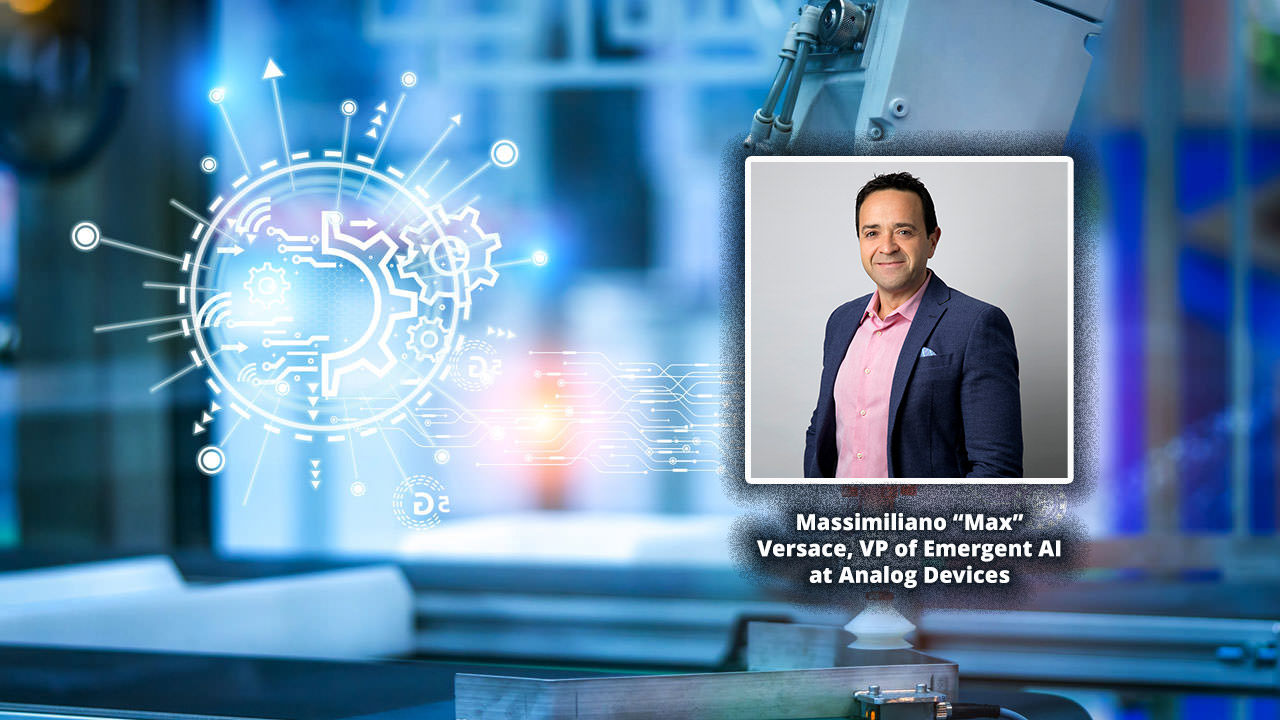
As the year comes to an end, Analog Devices is looking ahead to 2026: Massimiliano “Max” Versace, VP of Emergent AI at Analog Devices shares the technological advancements that will create new opportunities and shape our daily lives in the new year.
We are pleased to share with you the insights and predictions of Massimiliano “Max” Versace, VP of Emergent AI at Analog Devices.
Predictions for 2026
So here we go with the following predictions for 2026.
Prediction: Decentralized AI will appear in new-generation humanoid robotics by the end of 2026.
By late 2026, decentralized AI architectures merging sensing with neuromorphic and in-memory compute will transition from pilot programs to early commercial deployment. We’ll see humanoid robotics systems getting a bit closer to biological systems, where local circuits in sensory organs and spinal pathways handle reflexes and balance, allowing smoother, more adaptive movement, drastically reduced power consumption, and freeing the central brain to “think and plan.”
These technological leaps will start with intelligent sensors that embed novel AI compute, such as neuromorphic and in-memory-compute architectures, directly within the sensor. The combination of decentralized AI and novel AI compute architecture will dramatically reduce latency and power consumption, allowing always-on AI at the edge and freeing larger processors to focus on higher-level reasoning, planning, and learning, rather than micromanaging continuous sensorimotor control loops. By enabling real-time, low-latency AI processing at the edge, robots will become more efficient, responsive, and capable of near-biological sensory-motor skills. This shift will power a step change in their ability to engage complex, dynamic environments with fluid, reliable coordination and pave the way for practical and pervasive humanoid robotics.
Prediction: In 2026, we’ll see the rise of analog AI compute.
Historically sidelined due to scalability and precision limitations, analog compute is reemerging in 2026 as digital architectures face energy, latency, and memory bottlenecks with no solution in sight. This is especially critical in edge environments where real-time responsiveness and power efficiency are a must.
Analog AI compute uses the physics of the sensing and computing substrate to perform computation, transforming energy directly into AI inference. This is a different approach to AI compute vs. conventional digital processors, which separate sensing from computation. Analog AI collapses these layers into a unified framework where intelligence begins at the sensor itself.
By the end of 2026 we’ll see initial deployments and adoption of this technology, particularly in robotics, wearables, and autonomous applications, where analog AI enables real-time responsiveness, smoother interactions, longer battery life, and more natural behavior in the devices they power.